On December 09, 2025, a national workshop was held in Ouagadougou to close the #project “Strengthening the community resilience of agroforestry households in the Bankui, Sourou, Yaadga and Koulsé regions (RESICOM). “ with the various stakeholders (authorities, technical services, technical and financial partners, beneficiary communities).
The meeting, which served as a framework for project accountability, was chaired by Mr. Oumarou OUEDRAOGO, Director of Project and Program Coordination, representing the Minister of State, Minister of Agriculture, Animal Resources and Fisheries. “Looking at the results of our activities, we can see that they are in line with the government’s strategic priorities, which include improving people’s livelihoods and substantiallyincreasing production to achieve food sovereignty. Actions such as the development of rice-growing lowlands, market garden areas and the restoration of degraded land are essential factors in improving production“.

Mr Oumarou OUEDRAOGO, Director of Project and Program Coordination, representing the Minister of State, Minister of Agriculture, Animal Resources and Fisheries
As a reminder, this national accountability exercise follows on from the project’s Regional Technical Monitoring Committees held in the Koulsé, Yaadga and Bankui regions, which drew up a positive assessment of the RESICOM project’s action in the various implementation regions.

“To contribute to the sustainable strengthening of the resilience of agroforestry households, including IDPs, affected by the security crisis and climate change in the Bankui, Sourou, Yaadga and Koulsé regions. This was the aim of the project, which focused on 03 main areas:
- Small-scale producers, including IDPs, improve their resilience to food and nutrition insecurity by strengthening their livelihoods and increasing production;
- Women and young people improve their incomes through decent rural jobs;
- The populations of the project’s intervention regions live in an environment of peace and social cohesion, thanks to concerted management of shared resources, intra/inter-community dialogue and strengthened local governance.
At the end of 04 and a half years of implementation, important achievements include
- 222 hectares of lowland rice-growing areas of the LCP type have been created and are used by 1,920 households, including many internally displaced persons;
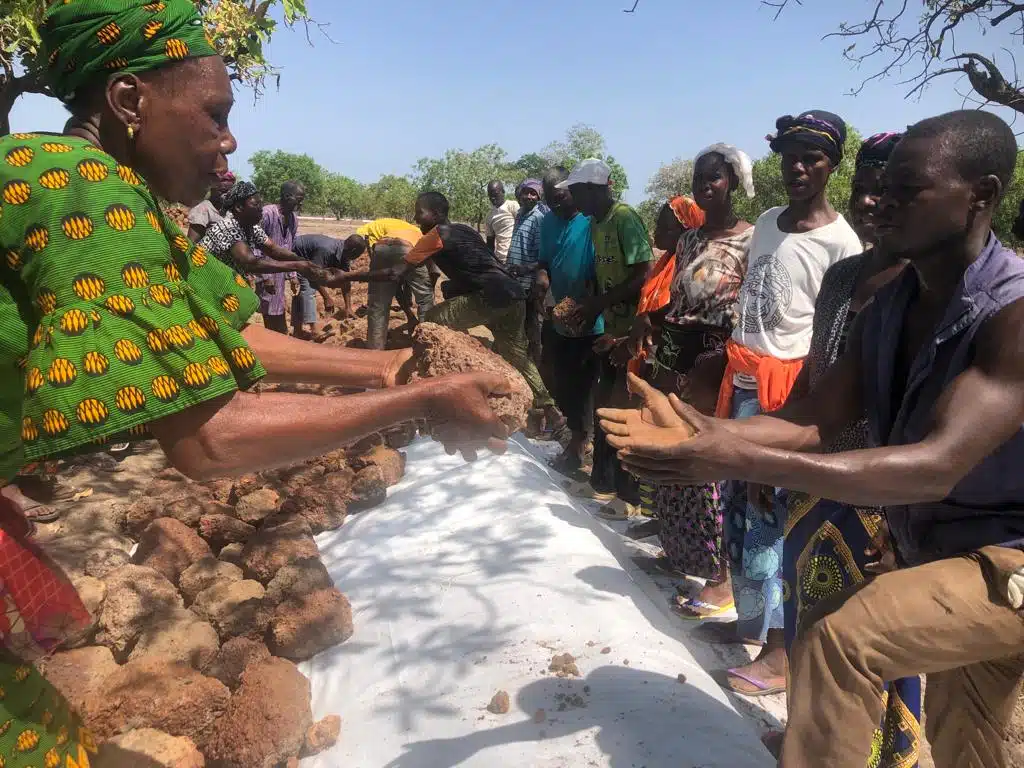
- 3,122 hectares of degraded land restored, providing a concrete response to the challenges of soil degradation and natural resource depletion;
- 45 hectares of market garden areas, equipped with solar pumping systems, developed for the benefit of small-scale producers, enabling them to diversify their activities and improve their income throughout the year;
- 10 onion storage warehouses (50 tons each);
- 06 vaccination pens were built, enhancing livestock protection and securing livelihoods for livestock farmers. In the same vein, 21 pastoral boreholes were built.

Participants discovered the project’s achievements through video clips.
According to Mr. Dieudonné R. ZAONGO, Country Representative of Solidar Suisse in Burkina Faso, these results were achieved through a combination of community-based approaches adapted to the resilience of vulnerable households. These include:
- MaBYZ (which means “Ma Baas Yiire Zaka” in the local Mooré language), a local initiative that frees mothers from childcare so that they can participate fully in production activities in the lowland rice fields and market gardens;
- reforestation by contract, a reforestation initiative that commits the beneficiary to greater responsibility in both the acquisition of seedlings and the planting and maintenance of trees on the basis of a contract drawn up with the bearer of the initiative in return for premiums to be paid according to the species and number of seedlings that have survived beyond their second year of planting;
- the solidarity granary, an endogenous community resilience solution that consists of a given community voluntarily building up food stocks during the harvest period, to be loaned to community members during the lean periods.

Mr. Dieudonné R. ZAONGO, Country Representative of Solidar Suisse in Burkina Faso, leader of the consortium implementing the RESICOM project
Mr. Bjorn Ronhof QVORTRUP, Chargé d’Affaires of the Royal Danish Embassy in Burkina Faso, expressed his satisfaction with the remarkable results achieved. “The report shows the positive effects of the RESICOM project on thousands of vulnerable people. This was made possible by the close collaboration between the consortium, the implementing partners and the Burkina Faso government.

Mr Bjorn Ronhof QVORTRUP, Chargé d’Affaires of the Royal Danish Embassy in Burkina Faso
Mr. Boureima SAWADOGO, RESICOM project beneficiary in the commune of Rambo confides, “Thanks to the support of the RESICOM project, I have benefited from a runoff water collection basin (BCER). Thanks to this BCER, I can water my crops in times of drought. The basin also enables me to do market gardening and fish farming, which bring me a lot of profit.”

Mr Boureima SAWADOGO, RESICOM project beneficiary in the commune of Rambo
The RESICOM project has been funded by the Danish Embassy in Burkina Faso. It is implemented by the consortium Solidar Suisse (lead) – SOS SAHEL International Burkina Faso – ONG in partnership with Ocades Caritas Burkina / Dédougou (Bankui), the Fédération des Professionnels Agricoles du Burkina (Yaadga) and the Association Wendkouni /Namentenga des Koulsé.

Beneficiaries took the opportunity to showcase their productions and processed products.
Watch the BF1 television report