From September 09 to 13, 2024, we carried out a mission to monitor the wet season on the RESICOM project sites in the lowlands of Bokin (Guibaré) and Manenga (Boulsa) as well as the CES/DRS developments. The visit enabled us to see how well the crops are progressing. We look back at some of the testimonies given by producers and those involved in agricultural technical services.

“My name is Madi OUEDRAOGO, and I’m a farmer in the commune of Guibaré (BAM province). The arrival of the RESICOM project in our commune is an opportunity for us to strengthen our skills and means of agricultural production. Before, not knowing the right techniques for rice production, I sowed rice like millet, on 25m2, my production didn’t exceed 03 carts. But today, thanks to the RESICOM project, the low-lying area is well developed (with water retention bunds), we’ve been introduced to good sowing techniques and provided with inputs (improved seeds, fertilizers). With all these conditions in place, I plan to harvest around 06 to 07 carts from my 25m2 plot at the end of the current agricultural season (2023-2024)”.

“I am Pamoussa LALLOGO, internally displaced in the commune of Boulsa (village of Manenga). I arrived in this village with my family in June 2023 following a terrorist attack. Being in my native village (Belga), despite the size of my family (03 wives and 10 children), I lived with dignity because I had land to cultivate and owned a herd of around twenty head (made up of sheep, goats and oxen). When I left my village, I didn’t take anything with me, but when I arrived here, I was welcomed by the locals, who provided me with accommodation, food and the land to produce the minimum to meet my family’s food requirements. In addition, I have benefited from a plot of land in this rice-growing lowland developed by the “Strengthening community resilience in agro-silvo-pastoral households in the Boucle du Mouhoun, Nord and Centre-Nord regions (RESICOM)” project for the benefit of local inhabitants and internally displaced persons. To facilitate the efficient exploitation of this lowland, the project supported us in the development, ploughing with a tractor, the provision of inputs (improved seeds, fertilizers) and for our participation in the development work, we benefited from remuneration which enabled me to meet the daily needs of my family. When I came here, I was idle, but thanks to the RESICOM project and the availability of local people, I’m carrying out an activity that will enable me, at the end of the current agricultural season, to have a substantial food stock to feed my family.”

Mr. Edouard YAMEOGO, Head of the Technical Support Unit (UAT) for the commune of Boulsa, supervising the Manenga village lowland, confides: “The RESICOM project’s activities fit in well with the agro-sylvopastoral offensive. This campaign, the supply of fertilizer planned for this lowland was redirected to another site, thanks to the inputs provided by the project for this site. In addition, the proper management of the lowland and regular monitoring by the coordinator and our technical services enable us to identify any shortcomings and rapidly implement solutions to promote the development of crops. At present, the crops are looking good, and we hope to harvest 04 to 05 tonnes per hectare if the rainfall remains well distributed”.

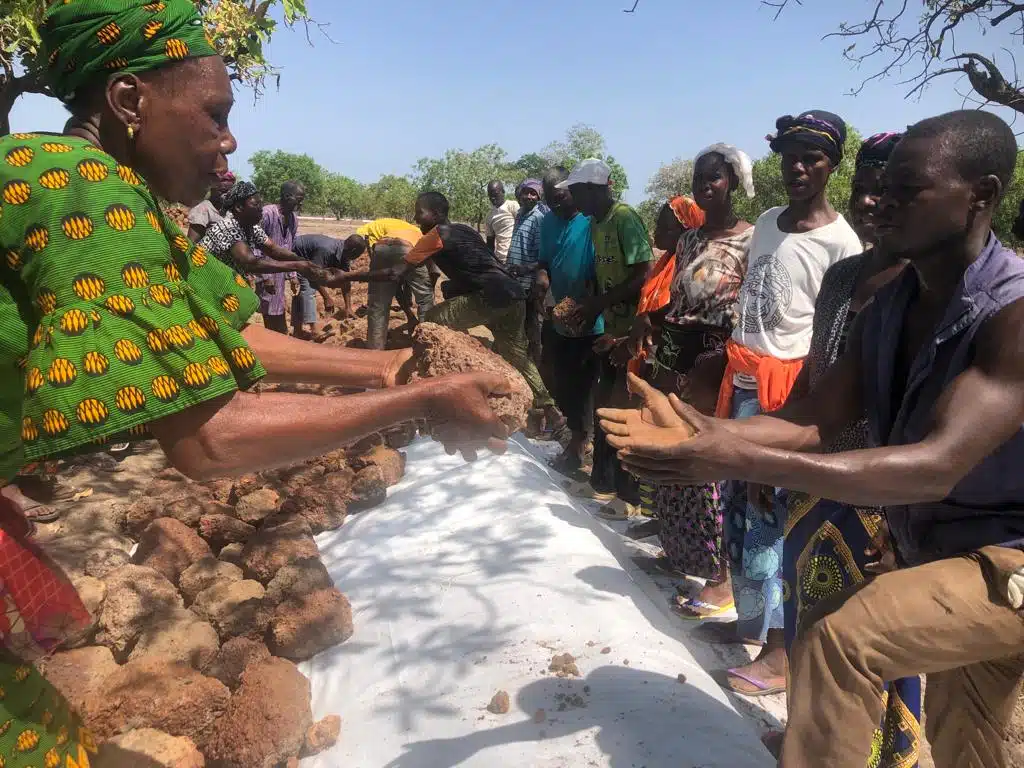
“I’m Adama SAWADOGO, and we welcomed the RESICOM project with great enthusiasm. In our village of Pissiga (commune of Korsimoro), for several years now, we have seen a reduction in our agricultural production due to soil degradation and impoverishment. On an area of one (01) hectare, we used to harvest barely 01 cartload of sorghum or small millet. But today, thanks to the adoption of CES/DRS techniques (Cordons pierreux in my case), we hope to harvest around 03 to 04 carts from the same area. We owe this to the support we have received from the RESICOM project: the provision of appropriate equipment (pickaxes, carts, hand protection gloves, etc.), the collection and transport of rubble to be used for the stone cordons on our fields, training in the proper application of the CES/DRS techniques, and the follow-up advice provided by the facilitator and technicians from the Ministry of Agriculture”.

Mrs Aguiratou SAWADOGO, who also owns a 01 Hectar Zaï Sorghum field in the village of Pissiga, is confident about the appearance of the plants. “For some years now, our production has been insufficient due to soil degradation and the lack of means and skills to manage our fields using CES/DRS techniques. This difficulty is now a thing of the past, because thanks to the RESICOM project, we have been strengthened both materially and technically. We are now well equipped to improve our agricultural production and ensure food security for our families.” she confides enthusiastically.

“I’m Halidou OUEDRAOGO, a farmer in the village of Kologsamba (commune of Boussouma). Thanks to support from the RESICOM project, this year I planted 02 ha of demilune and 01 ha of zaï with sorghum. Although the campaign is not yet over, I can already see a marked improvement in my production thanks to the adoption of these techniques. I hope to harvest 10 carts of sorghum from my 02-hectare field; in previous years, without these techniques, my production didn’t exceed 04 carts from the same area.”

“My name is Touinsida Fatimata SAWADOGO, and this year I planted 01 ha of sorghum using the 03-stone cordon technique. The adoption of this technique has favored the normal development of the plants. Before, my production was insufficient due to the scarcity of rain and the absence of adequate water retention facilities. But this year, looking at the appearance of the plants, I’m sure I’ll improve my agricultural production. I hope to have enough for the family’s food needs and sell some to meet other daily needs (such as health care).”