Strengthening the skills of decentralized technical services and model producers to set up pilot production sites for Pennisetum purpureum, a forage plant commonly known as “Maralfalfa”. This was the aim of the training course held in Ouagadougou on July 14 and 15 2022, which brought together model producers and agents from the departmental services of the Ministry of Agriculture, Animal Resources and Fisheries in the Nord (Gourcy and Rambo communes) and Boucle du Mouhoun (Oaurkoye commune) regions.
Over the course of 2 days, participants learned about the technical protocol for Maralfalfa production and maintenance. To enable participants to put into practice the technical knowledge acquired on the first day, and to see the results at first hand, the second day of training was used to visit a Maralfalfa production and exploitation site in the town of Koubri.

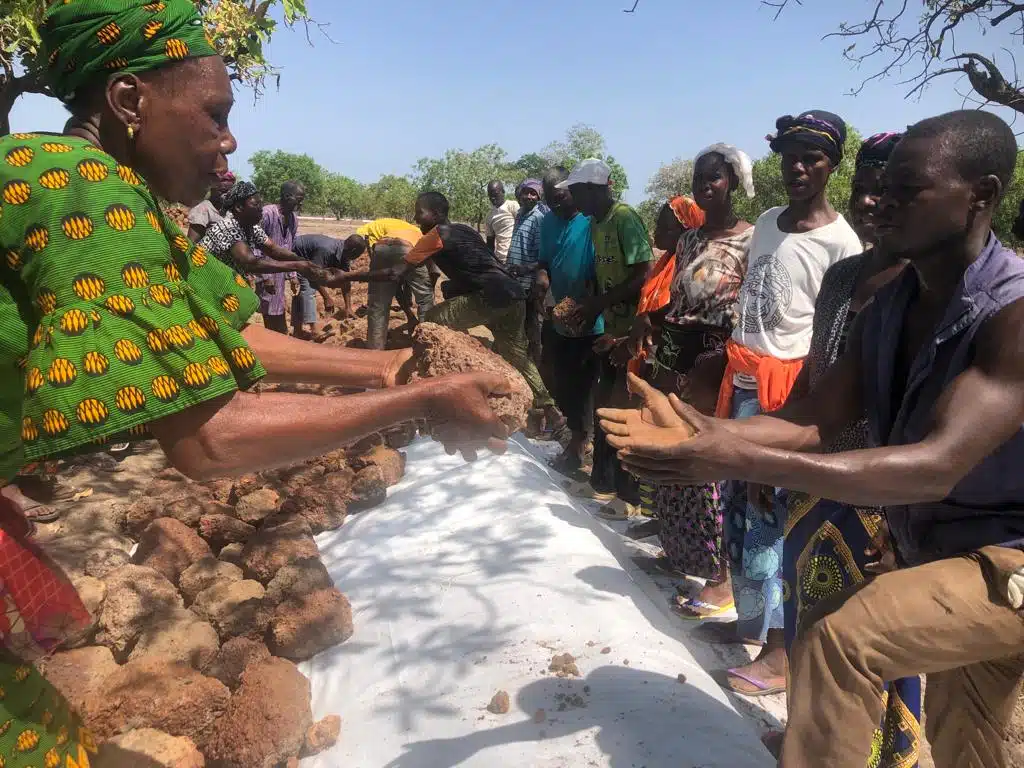
Participants took part in a demonstration of the various stages involved in planting Maralfalfa, namely: hole-digging, treatment of the holes (poquets) with organic fertilizer (FertiBioDur) and polyter (hydrodetenteur and growth activator with a subsoil life of 3 to 5 years), and planting the cuttings to germinate to produce Maralfalfa fodder (usable 6 months later).
At the end of the training course, participants were edified by the virtues of the plant and its potential contribution to fodder production in Burkina Faso, and confided that they would disseminate the knowledge they had acquired to promote the cultivation of this plant in their areas of intervention.

In the opinion of Mr. Noël SANDWIDI, agricultural agent in Zondoma (Gourcy commune), “Maralfalfa production will go some way to reducing conflicts between farmers and herders due to demographic pressure and insufficient grazing. The knowledge acquired during this training course will enable me, as an agricultural officer, to support the producers benefiting from RESICOM project sites dedicated to this crop, as well as other producers, in the adoption and successful production of Maralfalfa”.
As for Mr Issouf SANGARE, a farmer benefiting from the Maralfalfa production site (0.5 hectares) in the Ouarkoye commune, “Growing Maralfalfa will provide me with sufficient quality and quantity of fodder to feed my herd of around twenty head of oxen.
What role does Maralfalfa play in the RESICOM project?
According to experts, Maralfalfa is a high-yield forage (100 to 150 t/ha), with high nutritional values that can significantly boost livestock fattening and milk production. It can also be used in agriculture as a green manure and windbreak to protect riverbanks and reduce silting up of watercourses in low-lying areas. Properly maintained, a Maralfalfa site can produce fodder for up to 5 years.
One of the main thrusts of the “Strengthening the Community Resilience of Agroforestry Households in the Boucle du Mouhoun and Nord Regions (RESICOM)” project is to “respond to the needs of host populations, IDPs, women and young people through early recovery actions for 3,000 households and livelihood strengthening for 10,000 vulnerable households”.
To strengthen livelihoods, in addition to increasing agricultural production, the project aims to boost livestock production through the promotion of fodder crops. To this end, the project has initiated the cultivation of Pennisetum purpureum, commonly known as “maralfalfa”, a forage species that will be produced by 04 identified model producers (including 02 per region). Each grower has an area of 0.5 ha for growing “maralfalfa” under the technical supervision of the deconcentrated services in charge of agriculture. Cuttings for Maralfalfa production are currently being planted at various sites in the project’s two regions. To this end, 22,000 Pennisetum purpureum cuttings will be distributed to producers to support livestock activities and help prevent certain conflicts linked to insufficient grazing.

According to Mr. Dominique LOMPO, Provincial Director for Agriculture in the Boucle du Mouhoun region and Maralfalfa trainer, “Maralfalfa production can be an alternative to the sedentarization of animals, the professionalization of livestock farming and the reduction of conflicts between farmers and herders over natural resources”. To ensure the success of Maralfalfa production, he urged beneficiaries to follow the technical instructions carefully, as in his view, their success will serve as an example for the adoption of the crop by other producers.
As a reminder, the RESICOM project is being implemented by the Solidar Suisse-SOS Sahel International Burkina Faso Consortium with the support of local partners: Organisation Catholique pour le Développement et la Solidarité – Dédougou (OCADES) and the Fédération des Professionnels Agricoles du Burkina – Yatenga (FEPAB). It is funded by the Danish Embassy in Burkina Faso for the period 2021-2025.