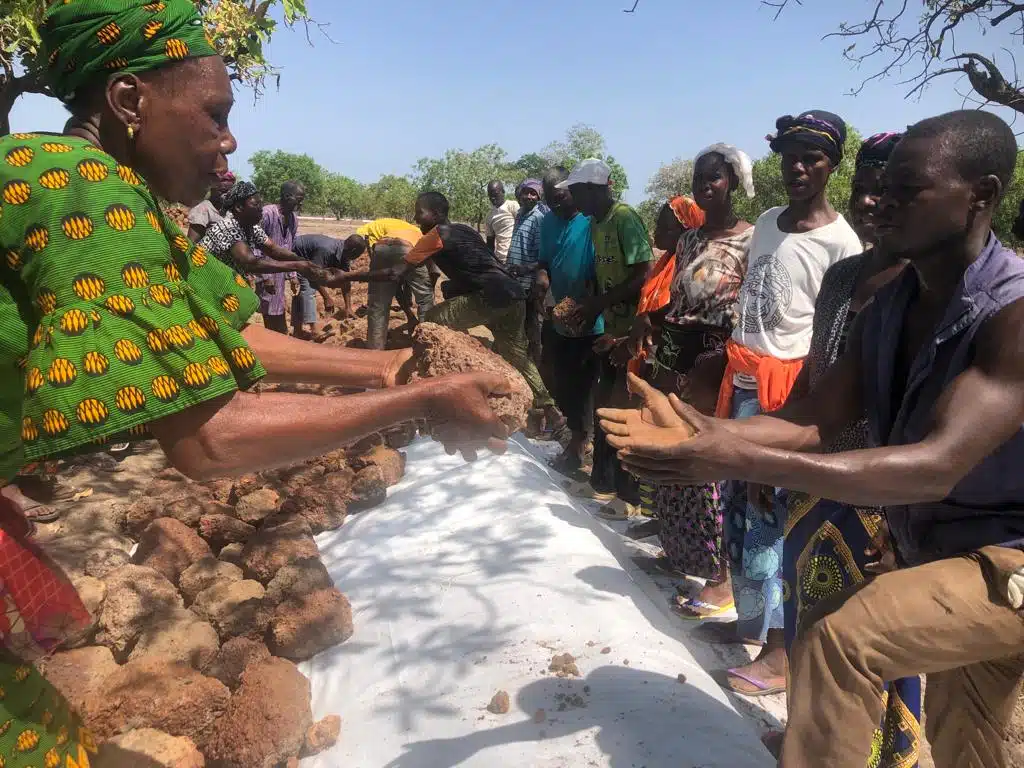
To provide answers to this question, the RESICOM project intends to experiment with this approach by setting up 10 Solidarity granaries in its intervention zones. On June 12 and 13, 2023, a training session was held in the village of Pourra (commune of Rambo), on the process of setting up, composing and managing the COGES (management committees) of the solidarity granaries. At the end of the training, Mr. Hamidou N. SAWADOGO, market garden producer and BCER (Bassin de collecte d’eau de ruisellement) promoter, was elected chairman of the village’s Grenier de Solidarité management committee.
The implementation of the solidarity granaries falls within the scope of RESICOM project output 1.1: “The productive assets of 3,000 shock-affected households, including 600 IDP households, are reconstituted”. To this end, the project intends to “Facilitate increased cereal production for 8,000 host households and the implementation of endogenous shock preparedness and response mechanisms for vulnerable households”. To achieve this, farmers are being trained in the techniques of Soil and Water Conservation/Soil Defense and Restoration (CES/DRS): so-called “intelligent” techniques for dealing with climate change that promote water retention and soil fertility, helping to improve agricultural production.
In addition, the establishment of solidarity granaries (food and seed stocks built up on the basis of community contributions, with the possibility of borrowing and repayment without money being involved) represents an endogenous solution for the availability of food and seed, accessible to people vulnerable to the effects of climate change. In this way, the beneficiaries of early recovery actions will improve their access to cereals and seeds in times of crisis.
To date, 05 solidarity granary stores have been built in the project’s two intervention zones: (02 in the North and 03 in the Boucle du Mouhoun).

Technical acceptance of the solidarity granary of Sao (rural commune in the Tchériba department, Mouhoun province)