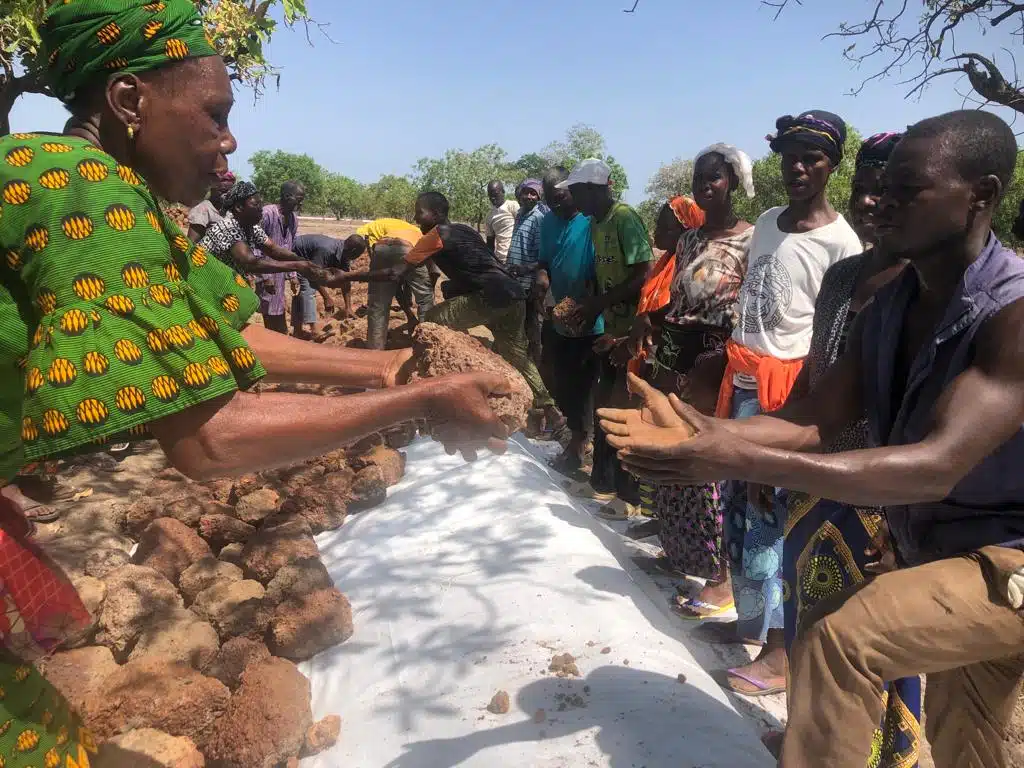
In Burkina Faso, the security crisis and climate change have led to increased food insecurity, poverty and massive population displacement. To provide a rapid response to the basic needs of vulnerable households, indigenous populations and internally displaced persons (IDPs), the RESICOM project is strengthening their production capacities in quick-win activities such as market gardening and sheep fattening. To better practice these activities, young people and women benefit from vocational training, the provision of production kits, and the development of production and storage infrastructures. In addition, to facilitate the marketing and financing of agricultural production and effectively combat food insecurity, initiatives such as the solidarity granary, warrantage and service poles have been set up endogenously. To find out more about the management and impact of these various initiatives on improving the living conditions of vulnerable rural populations, we went to meet them from June 25 to 28, 2024 in the Nord region.
TESTIMONIALS ON MARKET GARDENING

I’m MANDE Sanata, beneficiary of a plot of land in the market garden perimeter developed by the RESICOM project in the village of Minima (Gourcy commune). Before the project came along, I was a market gardener, but I had a lot of trouble accessing water for production, and at harvest time I had to sell all my produce for lack of a storage warehouse.
Today, thanks to the RESICOM project, all these difficulties are a thing of the past. We have a well-developed 03-hectare perimeter equipped with a high-flow borehole, a solar-powered pumping system and an onion storage warehouse with shelves that make it easier to preserve production. During the 2023-2024 campaign, I initially harvested and stored 187 kg of onions produced on 20 10 m2 beds. Then, on 10 beds, I harvested 100 kg of onions (of which I sold 50 kg at 10,000 FCFA and the rest of the production is used for my family’s consumption needs).
The RESICOM project is an initiative that has strengthened our means of production on several levels: we have benefited from training in good market-garden production practices, agricultural kits to facilitate production, and a storage warehouse that has enabled me to stock 187 kg of onions while waiting for a better market price. In addition, the use of bokashi organic fertilizer, which we made ourselves, has reduced the cost of production, and the onion is easier to preserve.

According to Indi SAWADOGO, president of the TegaWendé cooperative, which has benefited from the market gardening perimeter and onion storage warehouse in Minima, the RESICOM project has strengthened their means of production and conservation. “The organic bokashi fertilizer we’ve learned to produce is very beneficial: we no longer spend money on chemical fertilizer, and the onions produced with bokashi don’t rot quickly, so they keep longer. Also, thanks to the availability of the borehole, we have water at all times, and for optimum water management, we water our beds every 02 days on an alternating basis (by dividing the growers into 02 groups). We currently have around 900 kg of onions in storage (at a rate of 100 kg per person, with one pallet for 03 people). Also, the availability of the MaBYZ (space to free mothers from childcare), during the dry season improves the production of women with young children (the perimeter counts 120 producers with only 05 men). In addition, thanks to the RESICOM project, the perimeter has been secured with a wire fence, so we can use it during the dry and winter seasons for adapted crops. To ensure the long-term future of our cooperative and maintain the infrastructure after the project, we have opened a savings account with a balance of 50,000 FCFA, which we intend to replenish at the end of each production season.
TESTIMONIAL SHEEP FATTENING VOCATIONAL TRAINING

OUEDRAOGO Mariam is a beneficiary of the RESICOM project’s vocational training program. Thanks to the project’s support, Mariam has become a model woman in her village of Koumna Yargo (commune of Rambo). Nowadays, thanks to the profits from sheep fattening, she has become a trader in various goods and has savings of 150,000 FCFA in her account. As a reminder, Mariam is one of thousands of women trained by the RESICOM project in the practice of sheep fattening to improve their livelihoods. In addition to capacity building in good fattening practices, she was given 02 rams, a wire fence, a bag of cakes, a bucket, a wheelbarrow and a lickstone to start her first cycle of sheep fattening. At the end of this first cycle, she sold her 02 rams for 150,000F: on this gain, she bought back 04 rams in October 2023 to start her second fattening cycle. Of these 04 rams, she resold 02 at 140,000FCFA in February 2024. Of this amount, Mariam invested 35,000 FCFA in the beauty accessories business, 25,000 FCFA to look after her sick child, saved 25,000FCFA and the rest of the money was used for her family’s daily needs.

SORE Hamidou, husband of OUEDRAOGO Mariam , whom we met, expressed his gratitude to the RESICOM project, which has contributed so much to strengthening their livelihoods thanks to the support provided to his wife: “My wife’s activity is an added value in meeting the family’s needs. When I’m in difficulty, she doesn’t hesitate to cover the family’s expenses, including the children’s school fees”.
TESTIMONIALS ON THE SOLIDARITY ATTIC

“My name is OUEDRAOGO Salamata, and I’m a member of the solidarity granary in the village of Koundouba (Gourcy commune). The setting up of the solidarity granary is a good initiative that comes as a relief to us elderly people who don’t always have a sufficient harvest to cover their food needs for the whole year, due to the lack of manpower and climatic changes. The advantage of this granary is that it is managed by the women of our association, so when a member is short of grain, she can easily borrow a certain quantity to quickly meet her family’s food needs without exposing herself to ridicule. This year, during the lean season, I borrowed 16 kg of sorghum to meet my family’s food needs. Without the presence of this granary, I’d have difficulty obtaining it in a short space of time.”

Step 1: Measure the amount of grain borrowed

Step2: Signing the loan booklet
“The Solidarity granary is a good initiative that increases the availability of cereals in the village and helps combat food insecurity. Thanks to the RESICOM project, we were introduced to this approach, which relieves families in need of grain to feed their families during the lean season. Our association has 88 members, we are in our first year, for a first experience, we were able to store 12 bags of 100 Kg of sorghum with 07 loans granted,” added Salamata OUEDRAOGO, president of the RELWENDE Association, beneficiary of the Solidarity granary in the village of Koundouba (Commune de Gourcy).

Warrantage: an endogenous initiative to support the storage and marketing of cereals by small-scale farmers

Mr OUEDRAOGO MamoudouSecretary of the Rambo commune Warrantage store, in charge of stock management.
The feasibility studies carried out revealed that the facilities and infrastructure to support production, processing and marketing in the project area remain highly inadequate in relation to its potential, reducing household production capacity. To change this situation, one of the specific objectives of the RESICOM project is to organize small producers into cooperatives and facilitate their access to production, processing and marketing infrastructures. To this end, the project has undertaken the development of several infrastructures to support agro-sylvopastoral production, including: 227.41 ha of lowland rice fields spread over 13 sites, 45 ha of market gardening areas, 20 pastoral boreholes, 26 runoff water collection basins (BCER), etc. In addition, to facilitate the conservation, processing and marketing of production, based on the needs and potential of the project zones, the project has strengthened the equipment capacities of 20 processing units (shea butter, flour), 10 onion storage warehouses and 5 warrantage warehouses. To date, the 05 warrantage stores have already been built and are operational. As a reminder, the aim of these warrantage warehouses is to store and add value to agricultural products, facilitate small producers’ access to credit and develop IGAs. According to Mr. OUEDRAOGO Mamoudou, secretary of the warrantage store in the commune of Rambo : “the setting up of the warrantage store in our village is a good thing. Through this store, we no longer sell off our production at harvest time, and on top of that, we have the possibility of obtaining credit in exchange for a certain quantity of grain stored in the store, to meet our family needs while we wait to sell off our stock during the lean season (at a good purchase price). We are in our first cycle, with 27 members, 12 of whom are applying for loans of 300,000FCFA (to be repaid on the day of sale of the cereals, which takes place after 06 months’ stock). The quantity of cereals stored in the warehouse to date is around 3.5 tonnes of various products (sorghum, maize, small millet, groundnuts and cowpeas). For the next few cycles, we hope to mobilize more stocks through the various awareness-raising campaigns we’re running in the field to get more members.”

Family photo with the members of the management committee of the warrantage store in the commune of Rambo.